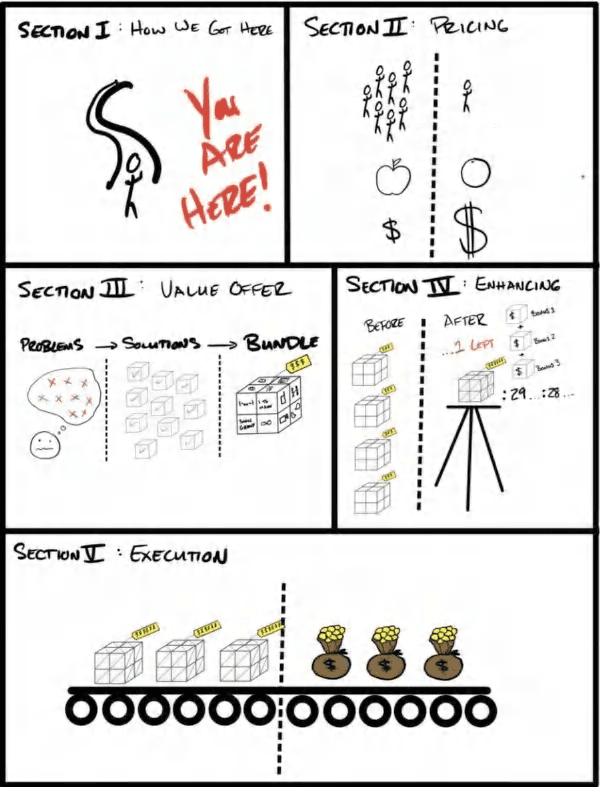
100m offer by Alex Hormozi
•career
# Chapter 1: How we got here!
### *“Make an offer so good people would feel stupid to say no to“*
Basic knowledge:
- No offer? No business. No life.
- Bad offer? Negative profit. No business. Miserable life.
- Decent offer? No profit. Stagnating business. Stagnating life.
- Good offer? Some profit. Okay, business. Okay, life.
- Grand Slam Offer? Fantastic profit. Insane business. Freedom.
***Although you can make the list of problems you face a mile long, which is a great way to stress yourself out, all these problems typically stem from two big kahunas:***
1. Not enough clients.
2. Not enough cash (excess profit at the end of the month)
**what you need to do:**
1. Provide value at no cost far in excess of what the rest of the marketplace charges.
2. Have entrepreneurs use materials that actually work and make money helping more folks
3. Earn the trust of the hyper-executor business owners who use the frameworks to scale their businesses to $3M$10M per year and beyond.
4. Invest in those businesses to make more impact at scale while helping everyone else for free.
---
# PRICING
# Chapter 2 - THE COMMODITY PROBLEM
***if your company isn’t growing, it’s dying.***
***The stock market grows at 9 percent per year.*** If we aren't growing at 9 percent per year, we are falling behind. Furthermore, if you’re in a growing marketplace, ***then you might have to grow at 20-30 percent per year***, ***just to keep up, or risk falling behind.*** So you can see how maintenance is a myth.
1. Get more customers
2. Increase their average purchase value
3. Get them to buy more times
```jsx
10 (New Clients/mo) * $1000 Lifetime value = 10,000/mo max revenue
```
**If you want to grow,** you’ve got to either **sell more clients every month** (while maintaining suitable margins) **or have them be worth more** (by increasing the profit per purchase or the number of times they buy).
Business terms.
**Gross Profit:**
**The revenue minus the direct cost of servicing an ADDITIONAL customer**. If I sell lotion for $10 and it costs me $2, my gross profit is $8 or 80 percent. If I sell agency services for $1,000/mo and it costs me $100/mo in labor to run that client's advertising, then my gross profit is $900 or 90 percent. Note: This is not net profit. Net profit is what’s left over after all expenses are paid, not just the direct costs of fulfillment.
**Lifetime Value:**
**The gross profit accrued over the entire lifetime of a customer.** This is gross profit multiplied by the
number of purchases an average customer will make over their lifetime. Using the example above, if the average customer
stays five months, and they pay $1,000/mo while it costs me $100 per month to fulfill, then their lifetime value is $4,500.
*A breakdown:*
```jsx
Revenue: ( ($1000/mo) * (90% Gross Margin) * 5 months ) = $4,500 Lifetime Value (LTV)
```
**Value-Driven vs. Price-Driven Purchases:**
S*ell your product based on VALUE, not on PRICE*
- **Commoditized** = Price-Driven Purchases (race to the bottom)
- commodities are valued at the point of market efficiency. This means that the marketplace drives the price down through competition until the margins are just enough to keep the lights on: “just enough” to become a slave to their business.
- **Differentiated** = Value Driven Purchases (sell in a category of one with no comparison.
## What Does A Grand Slam Offer Do?
***It’s an offer you present to the marketplace that cannot be compared to any other product or service available,*** combining an attractive promotion, an unmatchable value proposition, a premium price, and an unbeatable guarantee with a money model (payment terms) that allows you to get paid to get new customers . . . forever removing the cash constraint on business growth.
In other words, ***it allows you to sell in a “category of one,” or, to apply another great phrase, to “sell in a vacuum.” The resulting purchasing decision for the prospect is now between your product and nothing.***
It breaks down to this:
1. **Increased Response Rates (think clicks)**
2. **Increased Conversion (think sales)**
3. **Premium Prices (think charging a lot of money)**
### Real Life Grand Slam Offer Money Math: Before and After
Example:
**Old Commoditized Way (Price-Driven)** — Race to the bottom
**Commoditized Offer:** $1,000 down, then $1,000/mo retainer for agency services

**Note**: It all looks the same because they are all making the same offer.
- You pay us to work.
- We do work.
- Maybe you get results from that work. Maybe you don’t.
__________________________________________________________________________________________________
**New Grand Slam Offer Way (Differentiated, Incomparable) (Value-Driven)**
**Grand Slam Offer:** Pay one time. (No recurring fee. No retainer.) Just cover ad spend. I’ll generate leads and work your leads for you. And only pay me if people show up. And I’ll guarantee you get 20 people in your first month, or you get your next month free. I’ll also provide all the best practices from the other businesses like yours.
- **Daily sales coaching for your staff.**
- **Tested scripts.**
- **Tested price points and offers to swipe and deploy.**
- **Sales recordings.**
. . . and everything else you need to sell and fulfill your customers. I’ll give you the entire playbook for (insert industry),
absolutely free just for becoming a client.

**Summary Points**
the basic problem with commoditization and how Grand Slam Offers solve that. This gets you out of the pricing war and into a category of one.
---
# Chapter 2 - Finding the right market
A marketing professor asked his students, “If you were going to open a hotdog stand, and you could only have one advantage over your competitors . . . which would it be . . . ?”
“**Location!** ….**Quality!** …. **Low prices!** ….**Best taste!**”
The answer was: **“A starving crowd.”**
At the end of the day, if there is ***a ton of demand for a solution***, ***you can be mediocre at business, have a terrible offer, and have no ability to persuade people,*** ***and you can still make money.***
An example of this was:
The toilet paper shortage at the beginning of Covid-19. There was no offer. The pricing was atrocious. And there was no compelling sales pitch. But because the crowd was so big and so starving, rolls of toilet paper were going for $100 or more. That’s the value of a starving crowd.
***In order to sell anything, you need demand. We are not trying to create demand. We are trying to channel it.***
You just don't actually want to be selling ice to Eskimos. 😂

1. **Massive pain:**
1. **They must not want, but desperately need, what I am offering**. **Pain can be anything that *frustrates* people about their lives.**
2. **The degree of the pain will be proportional to the price you will be able to charge.**
3. ***When they hear the solution to their pain, and inversely, what their life would look like without this pain, they should be drawn to your solution.*** 👏
1. **Pro Tip:**
1. The point of good writing is for the reader to understand.
2. The point of good persuasion is for the prospect to feel understood.
2. **Purchasing Power:**
An entrepreneur had a very good system for helping people improve their resumes to get more job interviews. He was great at it. But try as he did, he just could not get people to pay for his services. Why? ***Because they were all unemployed!***
This, again, may seem obvious. But he thought, *“These people are easy to target. They’re in massive pain. There are plenty of them, and it's constantly adding new people. This is a great market!”*
He just forgot a crucial point: ***your audience needs to be able to afford the service*** you’re charging them for. Make sure your targets have the money, or access to the amount of money, needed to buy your services at the prices you require to make it worth your time.
1. So, our Freelancing website idea is going on the right path 50sar/month → 270sar/6 months → 510sar/1 year. 👌
3. **Easy to Target:**
Examples of this are avatars that have associations they belong to, mailing lists, social media groups, channels they all watch, etc. If our potential customers are all gathered together somewhere, then we can market to them.
You want to make sure you can target your ideal audience easily. For instance, you may want to serve rich doctors. But if your ads are being displayed to nursing students, your offer will fall on deaf ears, no matter how good it is.
1. **The freelancing idea** fits this category too. 📈
4. **Growing:**
Growing markets are like a tailwind. They make everything move forward faster. Declining markers are like headwinds. They make all efforts harder.
So you might as well find a good market to give you a tailwind to make the process easier.
### **Making This Real**

There are three main markets that will always exist: *Health, Wealth, and Relationships.* The reason that those will always exist is that ***there is always tremendous pain when you lack them.***
There is always demand for solutions to these core human pains. ***The goal is to find a smaller subgroup within one of those larger buckets that is growing, has the buying power, and is easy to target*** (the other three variables).
Think about what **you are good** at in regards to *health, wealth, and relationships.* Then think about **who might value your service the most (is in the most pain)**, ***has the buying power to pay what you want (money), and can be found easily (targeting).*** *As long as those three criteria are strong and the market isn't shrinking, you’ll be in good shape.*
### **Finding a suitable market - Three Levers on Success**
*The order of importance between markets, offers, and persuasion skills:*
**Starving Crowd (market) > Offer Strength > Persuasion Skills**
**Example #1:** Even if you have a bad offer and are bad at persuasion, you’re going to make money if you’re in a great market. If you’re on the corner hocking hot dogs when the bars close up at 2 am, with mobs of starving drunk folks, you’re gonna sell out your hotdogs.
**Example #2** **(most of us):** If you are in a normal market and have a Grand Slam Offer (great), you can make tons of money even if you’re bad at persuasion.
**Example #3:** Let’s say you’re in a normal market and have a normal offer. In order to be massively successful, you would have to be exceptionally good at persuasion. Then and only then will you succeed, with your persuasive skills serving as the fulcrum of your success.
Many empires have been built by exceptional **persuaders**. It’s just the hardest path to follow and requires the most effort and learning. Nailing your offer helps you shortcut this path to success. Otherwise, you will just have a normal business that takes exceptional skill to be successful (nothing wrong with that, but probably not what you signed up for).
### Commit to the Niche
You must stick with whatever you pick long enough to have trial and error. You will fail. In fact, you will fail until you succeed. But you will fail far longer if you keep changing who you market to, because you must start over from the beginning each time. So, pick then commit.
### Riches Are In The Niches
you can literally charge 100x more for the exact same product. Dan Kennedy was the first person to illustrate this for me, and I will do my best to pass on the torch to you in these pages.

1. Let’s say you sold a generic course on ***Time Management.*** Unless you were some massive time management guru with a compelling or unique story, it would be unlikely it would turn into anything significant. What do you think “yet another” time management course is valued at? $19, $29? Sure. Nothing to write home about.
2. So let’s imagine you make the product more specific, keeping the same principles, and call it ***“Time Management For Sales Professionals.”***
All of a sudden, **this course is for a more specific type of person**. We could tie their increase to even one more sale or one more deal and it would be worth more. But there are a lot of salespeople. So this might be a $99 product. Neat, but we can do better.
3. So let’s go down another level of niching and call our product…. ***“Time Management for B2B Outbound Sales Reps.”***
Following the same principles of specificity, now we know our sales people probably have very experienced deals and commissions. A single sale would easily net this salesman $500 (or more), so it would be easy to justify a $499 price tag.
4. Let’s just niche down one last level…. ***“Time Management for B2B Outbound Power Tools & Gardening Sales Reps.”*** Boom.
Think about it for a second, if you were a power tools outbound sales rep, you would think to yourself “This is made exactly for me” and would happily fork over maybe $1000 to $2000 for a time management program that could help you achieve your goal.
**End Result:** The market matters. Your niche matters. And if you can sell the same product for 100x the price, should you? I’ll let you decide.
### **Summary Points**
The purpose of this chapter is to **reinforce two things:**
1. don't pick a bad market. Normal markets are fine. Great markets are great.
2. once you pick, commit to it until you figure it out.
If you try one hundred offers, I promise you will succeed. Most people never try anything. Others fail once, then give up. **It takes resilience to succeed**
**Stop personalizing!** **It’s not about you!** If your offer doesn’t work, it doesn’t mean you suck. It
means your offer sucks. Big difference. You only suck if you stop trying. So, try again. You’ll never become world-class if you stop after a failed attempt.
If you find a crazy good market, ride it, and ride it hard. **And if you pair a Grand Slam Offer with a crazy market, you’ll likely never need to work again (seriously).**
So have this skill set
- The ability to accurately **assess markets by taking into account pain, money, targeting, and growth.**
- In your back pocket so that when lightning strikes, you can make sure it strikes twice.
**Having established how to nail a market, let’s get back to pricing. The first step to making crazy money is charging premium prices.**
---
# Chapter 2 - **CHARGE WHAT IT’S WORTH**
### **A compelling story shared by Alex and his father:**
Alex called his father after running presentations for the group below

**The exchange:**
**A**fter the initial pleasantries, he (the father) immediately dove into why he was calling — parental concern.
> “I saw the picture you posted of all your clients . . . ” he said, but in an unusually concerned tone. “I thought the event was for all your highest-paying clients? I didn’t know it was a big event. It looked like you had a thousand people there!”
>
> Alex said: “It was only for our highest-level clients, that wasn’t all our clients”, “Just the ones who pay $42,000 a year . . . our Gym Lords, like I told you.”
>
> “Every single person in that picture paid you $42,000?” He sounded almost frightened at the idea.
>
> “Yeah, wild right?”
>
> “Is it legal what you’re doing?” he asked. “Do they know they’re paying you that much?”
>
> “Yes, it’s legal. And of course they know. It’s not like magically siphoning money.”
>
> “That’s a lot of money. I hope what you’re giving them is worth it.”
>
> “If I made you $239,000 extra this year, would you pay me $42,000?”
>
>
> *“$239,000” because it was the average increase in topline revenue of a gym using our systems for 11 months.*
>
> “For sure,” he said, “I mean if I knew I was going to make that back. But what would I have to do?”
>
> “About 15 hours a week of work”
>
> “And how long would it take me to make the $239,000?”
>
> “Eleven months”
>
> “And how much of the $42,000 would I have to pay you up front?”
>
> “Nothing. Just pay me as you start making the money using the system”
>
“Oh,” he said, “well then, yeah, I would do it.”
“And that's why they do it, too.”
### Price to Value Discrepancy
**as Warren Buffet said, “Price is what you pay. Value is what you get.”**

Lowering prices is not the best way to increase the gap between price and value. The goal of a business is to make money, not just to get people to buy. Instead, increase the value-to-price discrepancy to raise prices and still offer a great deal.
**Do this:**
Alex Hormozi argues against pricing where the market is, as it leads to perfect market efficiency where businesses make just enough to keep going and the bottom 10-20% of operators get washed out. Instead, he suggests offering more value for a higher price and not copying competitors who are dead broke.
**Virtuous Cycle of Price**

**When you decrease your price**, you . . .
. . . **Decrease your clients’ emotional investment** since it didn’t cost them much
. . . **Decrease your clients’ perceived value of your service** since it can’t be that good if it’s so cheap, or priced the same as everyone else
. . . **Decrease your client’s results** because they do not value your service and are not invested
. . . **Attract the worst clients who are never satisfied until your service is free**
. . . **Destroy any margin you have left to be able to actually provide an exceptional experience,** hire the best people, invest in your people, pamper your clients, invest in growth, invest in more locations or more scale, and everything else that you had hoped in the goal of helping more people solve whatever problem it is that you solve.
**Here’s the reverse. This is what happens when you raise your prices.**
**. . Increase your clients’ emotional investment**
**. . . Increase your client’s perceived value of your service**
**. . . Increase your clients’ results because they value your service and are invested**
**. . . Attract the best clients who are the easiest to satisfy and actually cost less to fulfill,** and who are the most likely to ****actually receive and perceive the most relative value
**. . . Multiply your margin** because you have money to invest in systems to create efficiency; smart people; improved customer experience; scale your business; and, most importantly of all, to keep watching the number in your personal bank account go up, month after month, even with reinvesting in your business.
**Higher Price Means Higher Value (Literally)**
**SOME INTERESTING SCIENCE**
🍷 🍾 In a blind taste test, researchers asked consumers to rate three wines: a low-priced wine, a medium-priced wine, and an expensive wine. Throughout the study, the participants rated the wines with the prices visible. They rated them, unsurprisingly, in order of their price, with the most expensive being the “best,” the second most expensive being “second best,” and the third, cheapest option, being rated as “cheap wine.” 🥂
🤯 What the tasters didn’t know is that the researchers gave them the exact same wine all three times. Yet, the tasters reported a wide discrepancy between the “high-priced” wine and the “cheap” wine. This has deep implications for the direct relationship between value and price. 🧐
**The goal** is:
**To be so much higher than a consumer thinks** to themselves, **“This is so much more expensive, there must be something entirely different going on here.”**
Ideally, **this means pricing your services or product in such a way that it stings a little when they buy**. **That sting will force and focus their attention and their investment in your product or service.**
To charge high prices, you must outwork self-doubt and be confident in your delivery. Shortcutting the work will lead to failure. Your ***product must*** ***deliver***.
Experience gives you the confidence to ask for someone's entire year's salary as payment. You need to have a strong belief in your solution.
**Astro needs this for the business development project.**
The process can be replicated remotely using a "done-with-you" model instead of a "done-for-you" model.
This is a system for managing workers and sales that can be used in all stores. It includes communication between customer service and customers, communication within the team, and management of segments, kitchen, inventory, etc. The store owner can replicate this system in all branches.
### Summary Points
1. **First and foremost, charge a premium.** you will only be able to charge a premium because we provided more value than anyone else in the industry
2. Alex Hormozi offered a deal with a large gap between price and value, resulting in a virtuous cycle of providing the most value for the most money.
3. Alex Hormozi offered 100m for gyms that remained competitive, made the most money, had the latest and best acquisition systems, and could implement them quickly.
4. Alex Hormozi believes that most businesses need to raise their prices to grow, not lower them, and that profit is necessary to fuel growth and make a bigger impact.