Everyday Business Storytelling by Janine & Lee
•career
### The setting:
To establish setting, you can share data and trends that give the audience insight into places or situations where (usually) you’ve found shortcomings. The context you provide should offer just enoughinformation to ensure that your audience has the same baseline understanding of the situation.
***Setting builds critical focus***
### Characters
They establish an emotional element. As your audience observes your character’s emotional and/or behavioral response to a situation, it elicits their understanding. The more your audience learns about the situation—and the effects it has on your character—the deeper their interest grows. This is the path to advance your story forward.
Three types of characters
Unnamed Character.
Name Character
**You are the character**
Finally, you can introduce yourself as a character. This is when you might tell a personal story that relates to your overall theme or message. It’s commonly done in a keynote speech, TED talk, or some kind of setting where people feel comfortable putting themselves in a story. It’s a great way to add emotional appeal to your data and to connect more deeply to your audience.
> You can combine or separate setting and characters.
### **Conflict**
Having a conflict in your story can make your audience more engaged and interested. It gives them a reason to care and pay closer attention.
**Conflict is reassuring (and leads to the promised land)**
Identifying and addressing conflicts in your story can make you a hero twice - first when you identify the problem, and then again when you propose a solution to fix it.
It’s happening right now and is today’s “old,” entrenched story. The main cause of the discord is that this current situation is blocking opportunity or the possibility of a better future. Any conflict should pinpoint where incongruity or inadequacy of the current situation exists.
highlighting how complex the insurance purchasing process is. In the next slide, the conflict escalates to show how—currently—the future looks bleak for reaching the next generation of insurance shoppers.
Great business storytellers know how much conflict is enough to secure attention—and concern—but not overdo it. Piling on the conflict can be off-putting at best, and insulting at worst. With the right mix of setting, characters, and conflict, you will find that contextual sweet spot. You are ready to offer the crucial payoff your audience is craving: the resolution.
> *Great business storytelling is like a recipe, and you are the chef. Take care not to over- or under-pepper your story with conflict.*
>
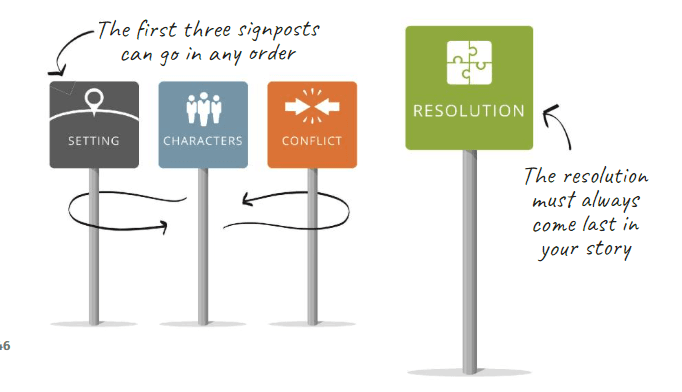
1. With your setting, you are shining the light on a certain market situation.
2. With your characters, you are establishing how a person or people are experiencing this situation.
3. And with conflict, you are illuminating a current problem
### Resolution
You may now unveil the new opportunity that will take the organization on the path to a rosier future.